

Before booking a hair transplant clinic in Dubai, ask who performs each step and how experienced the surgeon is. Ask how your hairline and donor area will be planned, what result is realistic and what support you get afterwards. Clear, specific answers tell you far more than a polished website or a quick chat.
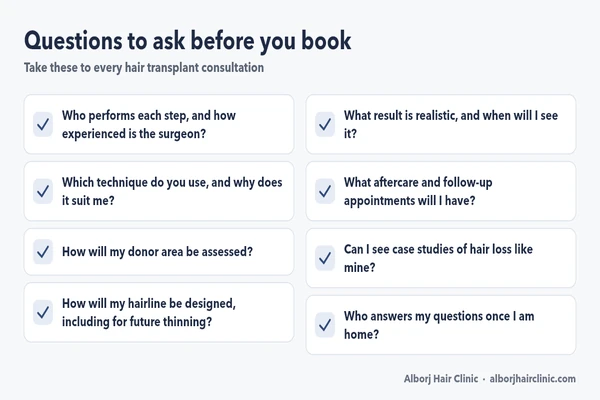
Below are ten questions to take to every consultation, grouped by topic, with what a helpful answer usually covers.
Who will actually perform your hair transplant?
1. Who performs each step of the procedure?
A hair transplant has several stages, including hairline design, extraction and implantation. Ask who carries out each one, so you know how involved the surgeon will be on the day. Many procedures involve a team, so it is reasonable to ask who does what.
2. How experienced is the surgeon?
Ask how many years they have worked in hair restoration and roughly how many procedures they have done. Membership of a professional body, such as the International Society of Hair Restoration Surgery (ISHRS), is also worth asking about.
A confident clinic answers both questions plainly. If the reply is vague, ask again.
Which technique will be used, and is your donor hair suitable?
3. Which technique do you use, and why?
Methods vary between clinics. DHI (Direct Hair Implantation), for instance, extracts follicles individually and implants them by hand using an implanter pen.
Ask for the method to be explained in plain words, including whether stitches are involved and how the scalp is numbed. DHI needs no stitches and is done under local anaesthesia.
4. How will my donor area be assessed?
The back and sides of the head supply the hair for a transplant, and that supply is limited. A careful assessment looks at how much healthy hair you have there and how much can sensibly be used. If your supply is limited, you should hear that plainly.
It is also fair to ask how the stage of your hair loss is judged. Surgeons usually use the Norwood scale for men and the Ludwig scale for women.
How will your hairline be designed, and what result is realistic?
5. How will my hairline be designed?
A natural look depends on the shape, height and angle of the hairline, not only on graft numbers. Ask how the design will suit your face and how it allows for future thinning.
6. What result can I expect, and when?
An honest answer always includes the timeline. Transplanted hairs often shed in the first weeks. Expect fresh growth from roughly the third month and the complete result at about a year.
Listen for realism. A good answer will mention that your own hair around the transplant can still thin with age.
“I would much rather a patient asks too many questions than too few. The consultation is where we agree on a realistic result together. When that picture is clear from the start, the year of growth that follows is far less stressful.”
What support will you get after the procedure?
7. What aftercare support do you provide?
Ask what instructions you will receive, how washing works in the first days and who will explain it all. Written instructions are useful to take home. Ask, too, what you should do if something does not look right in the first days.
8. What follow-up appointments will I have?
Growth takes about a year, so ask when the clinic will see you again and how your progress will be checked along the way. Regular check-ins also give you a chance to raise small worries early.
Can you see past work, and who answers your questions later?
9. Can I see case studies of your previous work?
Many clinics share before-and-after case studies. Look for cases similar to your own hair loss. Ask how many months after the procedure each one was recorded, as results keep developing for about a year.
10. How are questions handled after I go home?
Small worries often come up during recovery, especially during the shedding phase. Ask who you can contact, how, and how quickly you can expect a reply.
This matters even more if you are flying home after the procedure. Knowing exactly who to message makes the months of waiting much easier.
How should you use the answers?
Your hairline shapes how you look for years, so give this choice the same care as any lasting decision about your appearance. Write the questions down, take them with you and note the answers.
A few signs suggest you should slow down:
- Pressure to book on the spot
- Promises that sound too certain
- Vague answers about who does the work
- No mention of the growth timeline or of future thinning
The right clinic leaves you feeling informed rather than rushed. If you come away with clear answers to all ten questions, you are ready to make a confident choice.
About Alborj Hair Clinic
Alborj Hair Clinic is a hair transplant clinic in Mazaya Centre, Al Wasl, Dubai. Its surgeon, Dr Dimitrios Ziakas, has 24 years of experience and has performed more than 4,000 hair transplant procedures. He is a member of the International Society of Hair Restoration Surgery (ISHRS) and uses the DHI (Direct Hair Implantation) technique.
Before-and-after case studies are published on the clinic’s website, so you can review its work before you book a consultation.
Frequently asked questions
Is it fine to ask a clinic lots of questions?
Yes. A good clinic expects questions and answers them clearly. Feeling rushed or brushed off is a reason to slow down.
Which question matters most?
There is no single one. Who performs each step and how the hairline will be designed reveal a lot about a clinic’s approach.
Can I have a transplant if my hair loss is still changing?
A transplant suits pattern hair loss, and the surgeon will consider how yours may progress. The plan should allow for the surrounding hair thinning in future.
How soon will I know whether the transplant has worked?
You can usually tell at around three months, when new hairs start coming through. Judge the final result at around 12 months, once it has fully grown in.